

What I Captured, What I Learned, and What I’ll Do Differently Next Time
When it comes to photography, I’m always up for a challenge. I love learning new techniques, trying different styles, and pushing myself to grow behind the lens. So when a friend reached out and said he was looking to get his coral collection photographed—yep, real live underwater coral he grows and sells—I couldn’t say yes fast enough.
It was something I’d never tried before, but I was immediately intrigued. I didn’t really know what to expect—only that I wanted to capture the unique beauty of coral in a way that did it justice.
This was my first real dive into this kind of photography—something totally out of my comfort zone—and I couldn’t wait.
Spoiler alert: it was incredible. And I learned so much.
Once I got started, I was hooked. It turned out to be an amazing experience, full of challenges, surprises, and lessons I didn’t see coming. Here’s how it went—and everything I learned along the way.
The Prep Work (aka Obsessive Research Mode)
The second I said yes, I went into full research mode. I dove deep (pun intended) into coral photography, fish tank setups, and lighting terms I’d never heard of before. I spent hours learning about coral species, aquarium lighting, and how to not ruin your camera while shooting underwater (scariest part).
I ordered the gear I thought I’d need, including an underwater porthole housing for my lens and an orange color correcting filter, and waited—very impatiently—for everything to arrive.
The Gear I Used
For this shoot, I kept it simple:
- Camera: Canon R5
- Lens: Canon RF 100mm f/2.8L Macro
- Setup: Porthole for underwater photography
- Lens Filter: Tiffen 6785B 67mm 85B Filter
- Lighting: Fish Tank Lighting
The macro lens was perfect for capturing all the intricate details and patterns. The external light helped bring out colors, but I quickly realized my lighting wasn’t strong enough for every angle. I also ran into constant battles with reflections on the glass—a challenge I wasn’t fully prepared for.
The Shoot: Day of Chaos and Curiosity
I showed up ready, nervous, and excited. I slipped my lens into the housing, switched to macro mode, and started clicking away. Immediately, I realized I had no idea how tricky fish tank lighting would be.
The white balance was absolutely wild. Every photo was either too pink, too purple, or straight-up blue. Even with an orange filter to try to fix the blue light, it wasn’t cutting it. So I cranked my white balance all the way up to 10,000K (maxed out, baby!) and thought, Well… this is as good as it’s gonna get.
Twenty shots in, my camera was nearly slipping out of my sweaty hands because I was so paranoid about dropping it in the tank. I literally thought to myself, Why am I doing this?!
But then, I took the 21st shot.
And wow.
That’s the coolest photo I’ve ever taken.
(Okay, yes, I say that a lot, but this time it felt really true.)
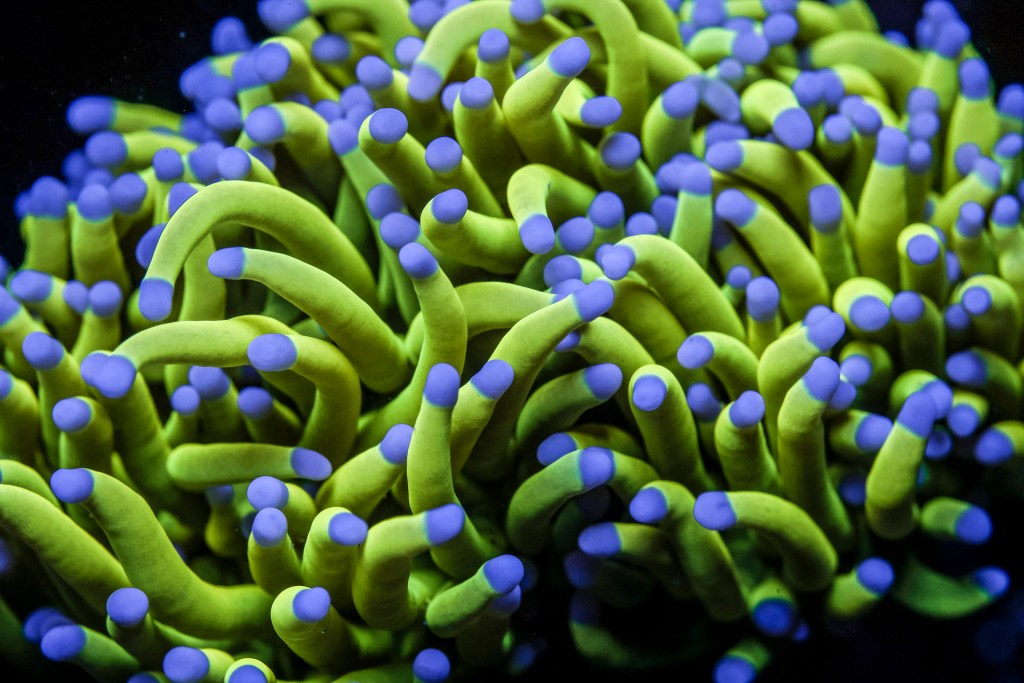
I changed the angle, tilted the camera to dodge the lighting, and kept shooting. After about 30 minutes of fumbling through white balance nightmares, everything finally started to come together.
The Experience (Behind the Scenes)
Picture this: I’m standing on a chair, my camera fully submerged in this fish tank, sweating and praying I don’t flood my gear. I’m tilting the camera to avoid blocking the tank lights, shooting from slightly off angles, and trying not to cast massive shadows on everything.
The lights were honestly one of the hardest parts. If I wasn’t blocking them, I was—wait, actually I was always blocking them. But if I tilted just a little, I could sometimes escape the harsh shadows.
There were other challenges too, like the coral at the top and bottom of the tank. With my 100mm lens, there’s a pretty strict distance it likes to focus at. If the coral was at the very top, I couldn’t even shoot it properly. If it was at the bottom, I knew I’d be cropping the heck out of it in post.
Once I took a step back and really started observing the coral—watching the subtle movements, the delicate patterns—it became almost meditative. There’s something special about photographing a living thing that stays still but feels alive in every detail.
It was awesome. I got to see the coral up close, learned about different species, and found a groove as the shoot went on.
The Wins
- The Macro Lens Delivered: It captured amazing textures and details I wouldn’t have seen otherwise.
- Some Images Turned Out Beautiful: Despite the struggles, I came away with a set of photos I’m genuinely proud of.
The Challenges
- Lighting Was Tricky: My setup didn’t provide soft, even lighting across all angles, and harsh shadows showed up in places I didn’t want them.
- Glass Reflections Were a Constant Battle: Without a polarizing filter, it was hard to avoid distracting reflections from the aquarium glass.
- Color Accuracy Was Harder Than Expected: Coral colors can look drastically different depending on lighting. I had to rely heavily on Lightroom to correct tones and bring back the natural vibrancy.
What I Learned
- Lighting is everything. I underestimated how much light coral photography really needs to bring out accurate colors and fine details. Soft, directional lighting made the biggest difference.
- Patience pays off. It’s not just about snapping a photo—it’s about waiting for the right moment, the right flicker of movement, the right play of light.
- Angles matter. Shooting through glass means being hyper-aware of reflections, background clutter, and your own positioning.
- Color correction is essential. Coral colors can shift dramatically based on lighting. I had to rely on both in-camera settings and post-editing to get them to look true to life.
- Tripods are Friends. I should’ve used one, but I couldn’t figure out how to make it work in this setup. Next time, I’ll problem-solve that ahead of time.
What I’d Do Differently
If I could redo this shoot, here’s what I’d change:
- Upgrade my lighting. A stronger, diffused setup would’ve helped eliminate harsh shadows and better highlight texture.
- Bring a polarizing filter. It would’ve helped reduce reflections on the glass and made editing easier later.
- Take more test shots ahead of time. I jumped in too quickly and spent more time troubleshooting than I needed to.
- Pre-plan some compositions. Going in with a shot list or vision board would have helped me be more intentional in my approach.

Final Thoughts
This shoot challenged me in all the best ways. It pulled me out of my comfort zone, made me think differently, and reminded me why I love photography so much—because it’s always evolving. There’s always something new to try, something to learn, and a fresh way to see the world.
Photographing coral for the first time was a humbling and beautiful experience. I’m already dreaming up how I’ll approach it next time—with better gear, more patience, and an even deeper appreciation for the incredible life just beneath the surface.
If you ever get the chance to try something completely different with your camera—do it. Even if you’re unsure. Especially if you’re unsure. That’s where the real growth happens.
Related Posts:
- Top 10 Favorite Coral Photos From My First Shoot (Coming soon)
- Coral Photography Hub (Coming soon)
- Step-by-Step: How I Edit Coral Photos in Lightroom (Coming soon)


One response to “My First Time Photographing Coral: What I Learned and What I’d Do Differently”
Love this. What I loved most was the enthusiasm to learn how to shoot something you’ve never shot before. Learning more about coral and doing as much research as you can, it’s cool when you have the opportunity to learn new stuff, especially things you’ve never really thought about taking photographs of! Reading the challenges is interesting too as you would think that shooting coral would be easy enough, no? WRONG. The smooth and flowy wave of the coral and how just a simple flow could alter the color and the lighting of the shot, fighting off the reflection from the tank and even dunking your damn lens to get a good shot is terrifying but exciting! The shots posted are so cool. The coral looks so alien, but it exists, it’s here and it’s alive in some way whether it be color or just generally alive lol. GOOD STUFF.
LikeLike